what temperature do duck eggs need to be incubated at
The first time I hatched craven eggs, I thought, "Wow, this is easy!" It only took 21 days. Information technology did require a few special pieces of equipment. Plus, I had to follow a few basic instructions. Only, for the most part, information technology seemed like nature did all the work.
When I tried to incubate my first clutch of duck eggs, it was a whole different story. The equipment involved and the fundamentals of incubating duck eggs are basically the same as with incubating chicken eggs. Even so there are a lot of nuanced adjustments you must brand to get reasonable hatch rates with duck eggs.
Thankfully, incubating duck eggs are notwithstanding simple if you understand the basics about how duck eggs are incubated in nature. It's also totally worth the trouble. There is admittedly nothing as adorable as watching a baby duckling hatch into the earth.
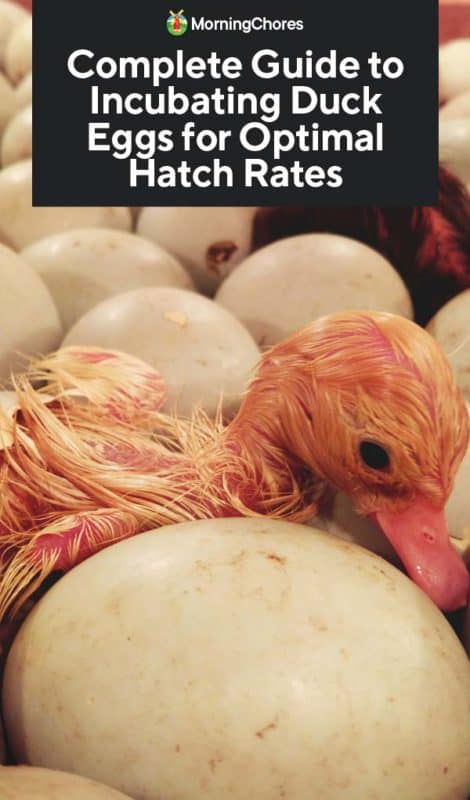
Duck Egg and Craven Egg Differences
If you asked poultry people the difference between duck eggs and chicken eggs, you'd probably hear some of these replies:
- Duck eggs are bigger.
- Duck egg shells are harder to crack.
- Duck eggs have more vitamins, cholesterol, and protein.
These things are all true. But when information technology comes to incubating duck eggs, the important thing to understand is why these differences exist.
Features of Natural Incubation

A duck egg is designed to be the perfect shelter and diet source for the transition from embryo to duckling. As such, duck eggs have fantastic features that are specific to the needs and natural habitats of waterfowl.
Allow'southward await at how these features play out during the natural incubation process and how to apply that knowledge when hatching your own duck eggs.
Ground Nesters

Ducks more often than not nest in the ground. Some breeds search for cave-like locations such as underneath the root mass of a downed tree or in a hole in the decaying body of a tree trunk. A few wild species even nest in boggy areas or on floating nests.
These locations all have one thing in common – loftier moisture content. Unlike chickens who adopt elevated, dry nests made of brittle materials like harbinger, ducks aim for mushy, decaying, moisture-holding nest locations.
Ducks typically create their nest bowls by making depressions in the soil or in decomposing plant thing to create a loftier humidity surround. Similar chickens, they also use their downy feathers from their underbelly to assistance trap oestrus in the nest.
Feather Wetters
Additionally, each fourth dimension broody ducks leave the nest, they groom themselves in a water source. They may preen a fiddling, only they don't preen long enough for their feathers to dry fully. That ways they go back to their nests partially wet and transmit that wet to their clutch of eggs.
The Porous Vanquish
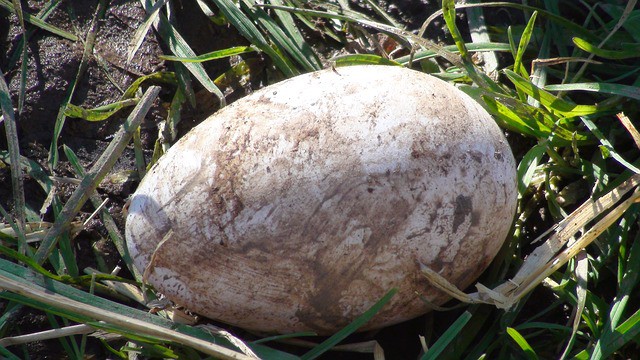
These nesting habits help explicate why duck eggshells are so much harder to crack then craven eggshells. It's nearly like you need to tear them autonomously later not bad them. That'due south because those actress thick shells are also extra porous as they are designed to hold water like a thin sponge.
In fact, in ane study on the moisture absorbency of eggshells, duck eggs out-performed craven eggs by 22%. This was even afterwards the inner membrane was removed, and the shells had been dried, ground, and heated to 1300℉. The bones structural brand-up of the duck eggshell is just more moisture absorbent than that of a chicken eggshell.
I've noticed that when I let my ducks sit their own nests, their eggs often absorb the water-soluble pigments in our nighttime loam topsoil. Amazingly, those dingy-appearing eggs seem to hatch at higher rates than the cleanest eggs.
It might only be that mama turns those eggs more than oftentimes, making them dirtier. But I suspect that the stained eggs are more porous and hold more water during incubation. That extra moisture then seems to ameliorate hatch rates.
Features Ducklings Develop During Incubation
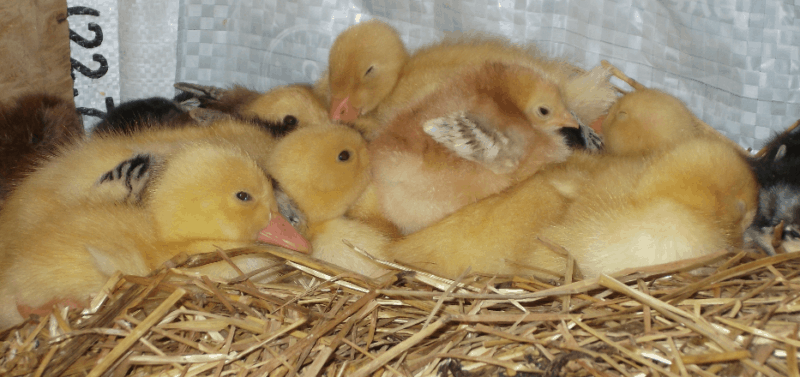
Craven eggs take 21 days to hatch. Nearly domesticated duck breeds take 28 days. Muscovy eggs accept 35 days. Some wild duck breeds accept betwixt 27-31 days. In human terms, the additional half-dozen-14 days may non seem similar a lot of time. But, for the duck sitting those nests, it's a huge divergence.
That's one-ii weeks longer for those dauntless mothers to be at extremely loftier take chances for predator attacks. That's also a whole lot longer for a nest sitter to exist limited to infrequent, short breaks to dash out for food and h2o. Also, every trip abroad from the nest increases the chances that something could eat those developing embryos.
Despite all the downsides, there are some important reasons why a longer incubation catamenia is necessary for ducklings.
Getting Water Ready
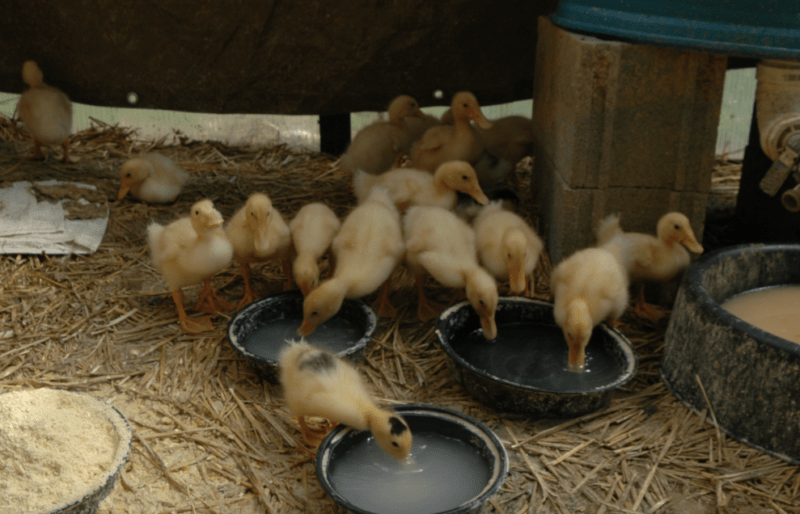
To survive in nature, ducklings must emerge from their shell set up to swim. Contrary to popular conventionalities, the oil gland on a duck'south tail is not required to make a duck waterproof. Practiced diet is the fundamental.
While incubating duck eggs, the nutrients in the egg are captivated by the embryo and used to course the bones, blood, organs, peel, and feathers. This is true for chicks also. However chicks simply need a calorie-free glaze of featherlike fluff to protect them from cold air temperatures. Their mamas will exercise the rest.
Ducks need their downy fluff to be structurally ready for cold water weather condition. Those kinds of heavy-duty featherlike feathers crave more than time and additional poly peptide and vitamins to form fully.
Prepare for Mating and Migration
Ducklings are too born more cold hardy than chicks. This is essential because the natural duck mating season occurs in early spring, while temperature fluctuations are nonetheless wildly varied.
It would seem a lot easier for ducks to nest later in the season once it warms up. Simply the natural nesting instincts start early in the season because ducklings will need a lot of protein in their diet to develop flying feathers and store fat to be ready for the winter migration.
Past starting ducks earlier in spring, nature times their births for when the food supply is ramping up and gives them several months to mature earlier traveling. Even though domesticated ducks don't migrate, they evolved from ducks that do. And then, they still retain those wild-inspired traits.
Chickens are not migratory birds by nature. They are more probable to go broody when the atmospheric condition is consistently warm, later on in spring or early on summertime. Chicks will accept to harden upwardly past wintertime besides, but they don't need extra fat stores for long flights and can exercise it in less fourth dimension.
These fundamental differences mean that ducklings must come out of the trounce more mature and set up for life than chicks do. The longer incubation menstruation and the extra nutrition in a duck egg makes that possible.
Tips for Artificial Incubation
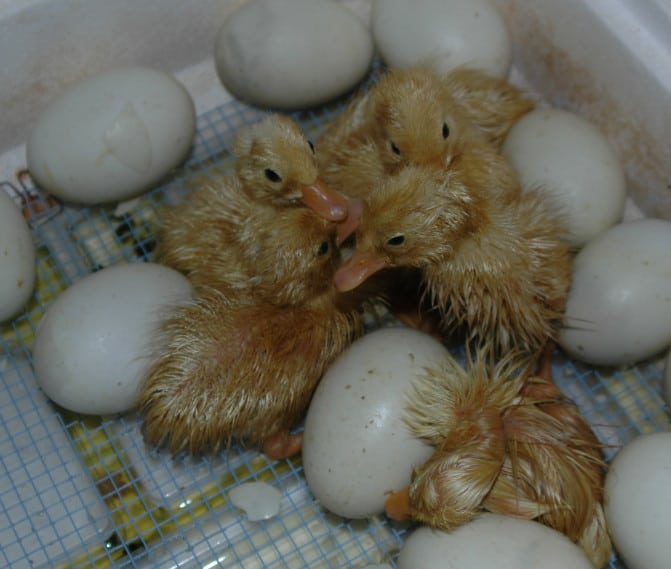
Quite frankly, in that location are nearly a one thousand thousand other amazing tidbits of information I could share virtually why duck eggs require different incubation procedures than chickens.
But I don't want to spoil all the fun of y'all making these observations on your ain. However, if you are going to incubate your own duck eggs, and not utilise a broody duck, I'd like to share some tips to help you have successful hatches.
Tip 1: Aim for Nature Inspired Incubation
Watching my ducks incubate their eggs has given me a lot of inspiration for how to have better hatches. For example, I used to freak out when I had to open the incubator considering I worried almost temperature and humidity fluctuations.
And then, I realized that even mama ducks become off the nest periodically. Mamas have to become eat, drink, and groom. On actually hot days, they stand next to the nest, presumably to let the eggs cool. On cold or windy days, mamas never get out the nest at all.
So, when you are using your incubator, attempt to think similar a mama duck. Your incubator is designed to maintain the temperature and humidity levels within. Just every time you open it, you expose those eggs to whatever conditions exist outside the box.
Duck mamas take their extended breaks when it is warm and sunny. If you warm the area effectually your brooder earlier you open it, yous can simulate those ideal weather for egg exposure. Avoid opening your brooder if it's cold or drafty.
Since our homes tend to exist very dry, make yourself a steaming cup of herbal tea and set information technology next to your incubator to sip while you work. That volition humidify the air just a bit and continue you lot calm too!
Tip ii: Rotate Like a Duck
Another affair I learned from watching my ducks is they don't just gyre their eggs back and along the manner an egg turner does. They rotate the eggs on the outside of the nest to the inside. This helps uniformly distribute the mama's body heat and humidity to all the eggs.
Your incubator will also be cooler and drier towards the edges and more boiling and warmer toward the heart, fifty-fifty with a forced-air fan model. Then, rather than merely rolling eggs back and forth, rotate them outside-in while turning.
I've noticed my ducks aren't very methodical in their turning frequency. But they do plow eggs more ofttimes early in the incubation cycle. They turn eggs much less frequently equally they progress towards hatching.
Breeders say you should rotate eggs equally often as you can for the kickoff week. After that, you tin cutting down to turning eggs a few times a solar day.
Tip three: Collect Your Clutch Like a Duck

Ducks only lay an egg a day (at best). Typically, they won't kickoff to sit those eggs until they have 8-12 of them collected. Until it is time to start, they shop them in the nest, protected by some feathers.
When y'all are gathering your clutch of duck eggs to hatch, collect them daily. Store them betwixt 55-75℉ and out of directly light. Kickoff incubating duck eggs within two weeks of when your first egg is harvested (or sooner when possible).
Also, similar my ducks, I've hatched muddied and make clean eggs. I've had success both means. However, when I've tried to hatch eggs that were laid randomly on the ground and not in a nest, those normally don't work out so well. So, using only clean eggs isn't a criterion for me. But using only eggs that my ducks accounted worthy of putting in a nest is.
Tip 4: Allow the Shell Tell
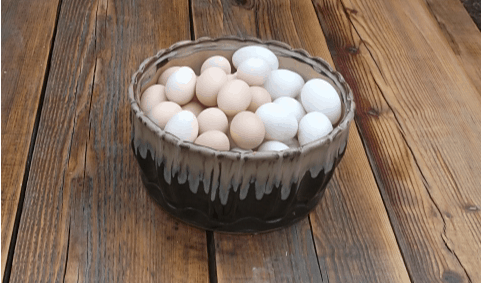
My ducks take never pushed eggs out of their nests as chickens do, though other duck keepers take reported seeing this behavior. Merely I've also never seen a misshaped egg in any of the nests that my ducks have sat. I suspect that a nest full of perfectly formed eggs helps trigger the brooding instinct in some ducks.
Then, when choosing eggs to hatch, choice those with the all-time shells. The shape should be wider at one end and narrower at the other. Don't choose overly large eggs that could incorporate double yolks. Reject eggs with cracks or excess calcium deposits.
Tip 5: Humidity is Fundamental
When you hatch chicken eggs, relative humidity should be about 50-55% for the get-go 17 days of incubation. Then, information technology's raised to seventy% for the last few days of incubation.
With ducks, aim for 55-60% humidity to start. And then, for the last 2-3 days of incubation, raise that humidity to fourscore%.
Maintaining those levels of humidity in a non-commercial incubator tin exist hard. Try calculation a couple of saturated sponges to your humidity tray. You may as well have to make full trays more oftentimes.
If that doesn't do it, run a humidifier side by side to your incubator. This way the air that is fatigued into the incubator is humid too.
Too, similar the fashion ducks deport moisture back to the nest on their feathers, spraying your eggs with cool water once a day but earlier you close the incubator lid can ameliorate hatch rates. Commencement this about x-14 days into incubation and stop when you enhance the humidity to prepare for hatching.
How to Incubate Duck Eggs
Now you know a bit nearly natural duck egg incubation and how you lot can emulate that process when doing artificial incubation. You also know about differences between chicken and duck eggs and hatchlings. But only to give you a handy all-in-one instruction set, here's a quick overview of the incubation process.
1. Incubator Prepare
Start your incubator and add water. Raise the temperature to 99.5℉ and humidity to 55-threescore%. When it is stable at those settings, put your eggs in the incubator.
Utilise our all-purpose incubation computer to estimate your hatch date and marking that on your calendar.
2. Daily Maintenance
Rotate your eggs ofttimes during the first week (e.g., seven times a twenty-four hours). Y'all can put a mark on one side of the egg to tell the difference.
Make sure to turn them an odd number of times daily. That way, when you are sleeping or have gone to work, the egg rests on the opposite side than information technology was on during that aforementioned period the solar day before. Later the first week, turn eggs about three times per twenty-four hours.
If you program to use an automated egg turner, make sure information technology is rated for use with duck eggs. The eggs are too big and heavy to piece of work well in some models congenital for smaller chicken eggs. Also, set eggs in the turner pointy side down, so the air sac in the wider egg side is always facing up.
Each fourth dimension you turn your eggs, check the temperature and humidity to ensure your incubator is working well. Add water to your humidity trays every bit needed to maintain those high humidity rates.
About 10-14 days into incubation, start spraying your eggs once daily before closing the incubator lid subsequently turning.
three. Hatch Preparation
Almost 2-3 days before hatch time, raise the humidity in your incubator to 80%. Drop the temperature to 98.5℉.
Remove the eggs from the egg turner, if you are using one, and fix them on the incubator floor.
At this point, terminate spraying and turning the eggs. However, continue to make sure the temperature is correct, and the humidity stays high. Don't open up the incubator unless necessary to add together water to your humidity tray. Then, be quick almost it.
Also, get-go listening. The ducklings will begin clicking and peeping as they ready to go out the shell. This is supposedly how the ducks tell each other to begin hatching, so they all come out around the same time.
You can peep dorsum at them if you desire. I can't swear it helps. But this is when mama ducks make sounds that help her ducklings imprint and recognize her as their guardian. Since yous are going to be mama, it's worth a endeavor.
Next, the ducklings volition first pipping. Pipping is the procedure of using a pointed bump chosen an egg tooth on the meridian of their bill to break free from the egg. Yous'll hear tapping and cracking. After pipping, there might be a delay as ducks turn in the shells and so apply their anxiety to expand the cracks and escape.
This is the moment when ducks unfurl from the shell, looking like a scrawny, drowned duckling. Take no fear, though. Later on a few minutes residuum, they'll brand their way up to their feet and start looking perkier.
Annotation: Commercial breeders employ a different device for hatching. But at dwelling, your incubator is usually used for incubating duck eggs (or other poultry) and hatching.
4. Postal service-Hatch
After hatching, leave ducklings in the incubator until all of the hatchlings are completely dry. It tin can accept thirty hours for a whole clutch to hatch. Occasionally it takes longer, only that typically only happens if the incubator had problems (e.one thousand., humidity issues, too low temperatures).
Resist the temptation to accept some ducklings out before others. Opening that incubator now can mean disaster for any late ducks not quite prepare to pip yet. Once the ducklings are dry, transfer them to the brooder and start your duckling care procedures.
Helping with Hatches
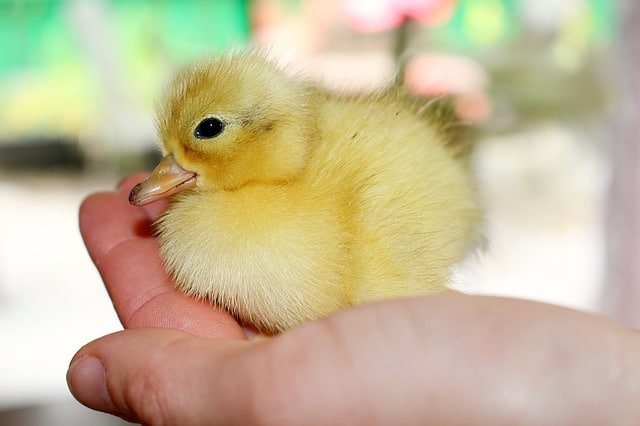
There's a lot of advice on the internet about whether to aid with hatches or non. I even so don't know the answer. I've tried to scissure the lawmaking on when to assist and when not to. Just, frankly, one time I got my incubation practices down, all my ducklings made it out on their own.
I can tell you lot that most duck hatch bug result because of humidity issues. Those humidity issues usually cause a duck to be underdeveloped at hatch time.
Ducks that can't make it out of the shell often abound slowly and are at greater risk for existence trampled past larger siblings. Too, those ducks don't always have waterproof feathers at birth and aren't cold hardy. So, they are at risk of catching a chill from playing in their drinking h2o or being around their wet siblings.
Nonetheless, in some instances, helping with a hatch has a happy ending. So, it'south always a tough call.
If you do help with a hatch, be prepared to give those ducklings actress care until they are as salubrious as the residuum of the flock. Also, know that fifty-fifty your best efforts might not exist enough to salvage an underdeveloped duckling.
Determination
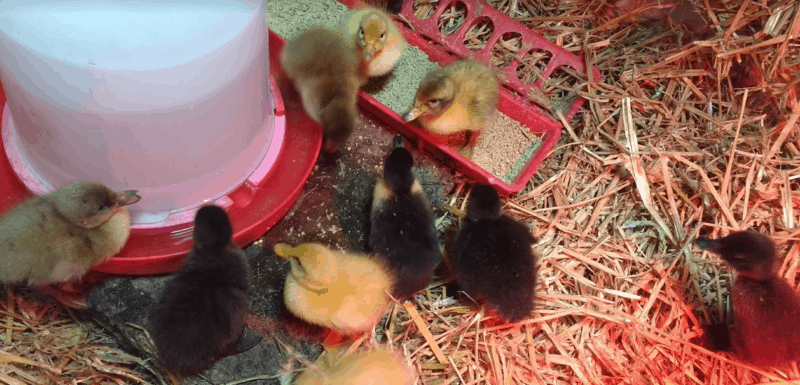
Incubating your own duck eggs or having a broody mama exercise it for you is a fascinating experience. In that location are some challenges, and not every hatch volition exist perfect. Yet, the whole process is a miracle and a pleasure to participate in.
Too, don't forget, when y'all purchase ducklings from breeders, you can often buy them sexed. At home, you lot go what nature gives you lot. And so, don't commencement counting your laying ducks earlier they hatch! (Alarm – I in one case hatched 21 males and just 9 females).
Was this article helpful?
Yeah No
nortonbreventowne.blogspot.com
Source: https://morningchores.com/incubating-duck-eggs/
0 Response to "what temperature do duck eggs need to be incubated at"
Postar um comentário